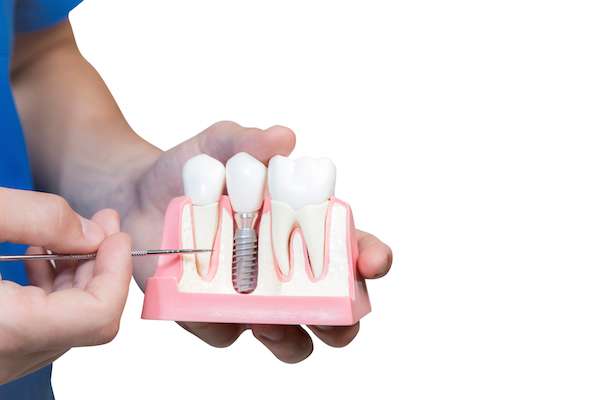
 Gum disease, if left untreated, often results in tooth loss, leaving many patients to wonder if they can get dental implants. Even gum disease patients who do not develop the advanced form of the disease, known as periodontitis, may want to replace missing or decayed teeth with implants. Is this possible, or will unhealthy gums interfere with the success of the implants?
Dental implants require healthy gums
Dental implants look and act like real teeth. A dental implant consists of a titanium steel root that a dentist inserts directly into the jawbone to replace the missing tooth. The dentist then leaves the implant to heal for a period of between four and six months. During the healing process, the steel root actually fuses to the jawbone via a process called osseointegration. The success of this first step is essential to the success of the overall procedure. If the implant does not fuse, it can just fall out, like the natural teeth did.
Implants may not take for a few different reasons. When it comes to periodontal or gum disease, there are two major concerns. One, the implant needs underlying bone matter that is both wide and thick enough to support the faux root. If gum disease has advanced to the point where the jawbone is deteriorating, it may not get that support.
Two implants, like natural teeth, need the gums to surround the root and lower crown. Untreated gum disease continually eats away at the gums, meaning, again, that the implant would not receive the proper support.
Implants are not out of the question for patients with gum disease
The good news is, individuals who live with any stage of gum disease can almost always qualify for dental implants after undergoing certain treatments and procedures. Patients who live with mild to moderate cases of gum disease may simply have to bring the disease under control. Doing so can entail frequent dental cleanings and a strict oral hygiene routine. A dentist may also recommend that the patient avoid certain habits or substances that may interfere with the healing process, such as smoking, chewing tobacco or drinking alcohol.
Once the disease has cleared up, the dentist may refer the patient to an oral surgeon to determine if the mouth is ready for implants. If the patient’s case of gum disease was very advanced, the oral surgeon may determine that bone or gum grafting is necessary before the implementation of dental implants.
Bone grafting involves building the bone structure back up via the use of donor bone or bone from another area of the patient’s body, such as the hip, jaw or tibia. Gum grafting involves correcting gum recession via the use of healthy tissue from the roof of the mouth.
Check out what others are saying about our dental services on Yelp: Dental Implants in Weymouth, MA.
Conclusion
Not everyone may be a candidate for dental implants right away. However, with the proper dental care and possibly after undergoing certain procedures, almost anyone can benefit from implants. If you live with gum disease, talk to a dentist about your tooth replacement options.
Request an appointment or call Dr. Frederick F. Nafash and Associates at 617-822-3400 for an appointment in our Weymouth office.
Related Posts
You expect your dental implants to last for years. Most do, since implant success rates stay high when placed and cared for the right way. Still, problems can start small and feel easy to ignore.Early signs of dental implant failure often include ongoing pain, swelling, bleeding gums, or a loose implant, and you should not…
If you lost a tooth years ago and never replaced it, and delayed dental implants, you might wonder if it's too late to do something about it now.Maybe you've been living with a gap in your smile or dealing with dentures that don't feel quite right. The good news is that time alone doesn't mean…
Dental implants are a highly effective solution for replacing missing or damaged teeth. They offer a permanent and durable option that not only restores the function of the teeth but also enhances the smile's appearance. As a modern and advanced treatment, dental implants have become the preferred choice for individuals seeking a long-lasting and natural-looking…