Cleaning single dental implants
Although a dental hygienist can clean the implant's abutment and the crown, the patient must also perform daily maintenance. Signs of improper home care include:
- Bleeding
- Red and swollen gums
- Pain when chewing
- Bad breath
- Bad taste in the mouth
Taking a small amount of extra care when cleaning a single dental implant can shield surrounding teeth from bacteria and increase its longevity.
Brushing
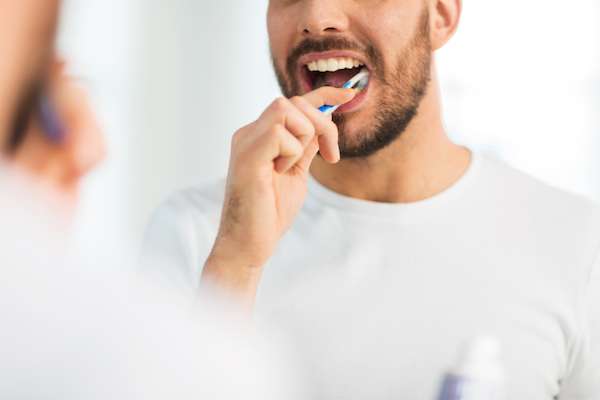
Brushing twice per day is necessary for patients with and without implants. Patients with dental implants must gently brush the crown, using a soft nylon brush to avoid scratching its surface. Oral bacteria can migrate into the jaw through scratches on the crown.
Using mild toothpaste
Unlike natural teeth, implant crowns have an acrylic surface that abrasive substances such as baking soda can wear away. Worn surfaces create access points for bacteria that can infect the jaw and the tissue around the implant. Brushing with a mild toothpaste eliminates this concern.
Water flossing
Water flossers have parts that can direct water flow deep inside the space between the crown and the gums where bacteria accumulate. A pulsating hydraulic force of room temperature water washes away plaque and debris and is gentle enough to apply every day.
Alternative flossing
Soft interdental brushes can achieve the same level of cleaning that water flossing provides. Standard string floss is inadvisable for use near dental implants because it can shred and enter the gum tissue causing infection. Specially designed floss consisting of shred-resistant stiff ends and a pliable middle can safely clean the area where the crown's edge meets the gumline.
Gum stimulating
Patients can gently massage the gums with stimulators to send nutrient-rich blood to the implant region. A gum stimulator is also an excellent cleaning device consisting of a long metal or plastic arm supporting a small triangular-shaped rubber or silicone tip that reaches beyond the gumline near the implant crown to scrape away plaque. It can enter the tight space between the crown and other teeth to loosen trapped debris.
Cleaning implants that support bridges and dentures
Whether a patient has a single implant or multiple implants, the cleaning methods are the same, with some variation. Additional tools in a home care arsenal can benefit patients with implant-supported bridges and dentures.
Interdental brushing
Patients can use small, narrow brushes with soft bristles to clean implant-supported bridges or dentures near the gumline where standard toothbrushes cannot easily reach. Subtle changes in design depend on which part of the mouth is cleaned.
Mouth rinsing
Patients can use small, narrow brushes with soft bristles to clean implant-supported bridges or dentures near the gumline where standard toothbrushes cannot easily reach. Subtle changes in design depend on which part of the mouth is cleaned.
A mouth rinse can penetrate spaces that other home care tools can not reach. Antibacterial rinses can dislodge debris while killing germs that can cause periodontitis.
Conclusion
Dental implants can last a lifetime with proper cleaning. Rigorous home care is essential but does not take the place of in-office deep cleaning.
Request an appointment or call Dr. Frederick F. Nafash and Associates at 617-822-3400 for an appointment in our Weymouth office.
Related Posts
You expect your dental implants to last for years. Most do, since implant success rates stay high when placed and cared for the right way. Still, problems can start small and feel easy to ignore.Early signs of dental implant failure often include ongoing pain, swelling, bleeding gums, or a loose implant, and you should not…
If you lost a tooth years ago and never replaced it, and delayed dental implants, you might wonder if it's too late to do something about it now.Maybe you've been living with a gap in your smile or dealing with dentures that don't feel quite right. The good news is that time alone doesn't mean…
Dental implants are a highly effective solution for replacing missing or damaged teeth. They offer a permanent and durable option that not only restores the function of the teeth but also enhances the smile's appearance. As a modern and advanced treatment, dental implants have become the preferred choice for individuals seeking a long-lasting and natural-looking…