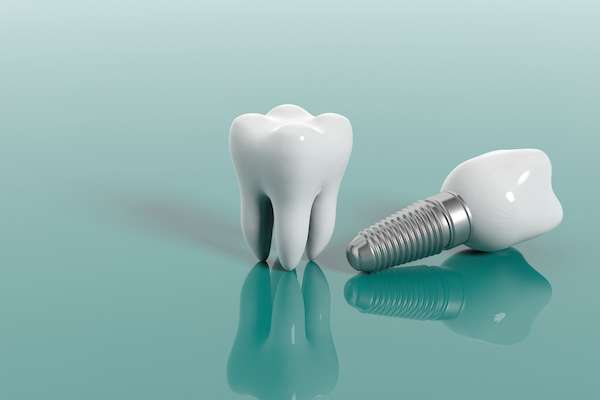
 Dental implants are often used to replace individual teeth but can also offer multiple teeth replacement options. Such options include cantilever bridges, implant-supported bridges and implant-supported partials.
Dental implant options for patients missing multiple teeth
Depending upon the condition of the person's gums and jawbone, a single implant can sometimes be placed to support two adjacent teeth. More commonly, multiple implants are used to anchor fixed bridges or removable partials.
Cantilever bridge
If a patient needs to replace two adjacent teeth, it is sometimes possible to use one implant with an additional tooth suspended to it. If the teeth are not adjacent, then two implants need to be used.
Implant-supported bridges
An implant-supported bridge can be used to replace two or more teeth on the same arch. This process involves placing multiple implants to serve as supports for the bridge. Implant-supported bridges have a number of advantages over traditional fixed bridges:
- Many patients find them more comfortable, stable and durable, with no gum irritation.
- Patients with insufficient jawbone to support individual implants can use them.
- Support from adjacent natural teeth is not needed.
- The implants act like teeth roots so the jawbone is better preserved.
- Because less deterioration occurs, implant-supported bridges maintain function and appearance for a longer time.
- The bridges do not have to be removed for cleaning or sleep.
- No adhesive is required.
Implant-supported partials
Implant-supported partials function similarly to bridges but are removable rather than being fixed in place. People who are transitioning from traditional partial dentures may find implant-supported partials an easier adjustment than a fixed bridge. This can also be a good option for patients who grind their teeth at night because they can remove the partial, protecting it from potential damage. They are effective multiple teeth replacement options for people who have difficulty brushing and flossing the teeth because the partial can be removed and cleaned outside of the mouth.
The dental implant process
Receiving dental implants is a multistage process that begins with an examination to determine whether the dental implant procedure is right for the patient's needs. The next step is to replace, remove or repair any damaged dental structures. The dentist then uses 3D digital X-rays and dental impressions to create a treatment plan and sends it to a lab to create the prosthetics.
Next, one or more dental implants are inserted below the gum line. Over the next two to six months, osseointegration occurs, which fuses the jawbone to the implants, providing sufficient support for the bridge or partial. Finally, the patient returns to have the bridge or partial placed.
Check out what others are saying about our dental services on Yelp: Dental Services in Weymouth, MA.
Conclusion
Multiple teeth replacement options in the past focused on fixed bridges and partial dentures supported by the patient's natural teeth. Modern dental implants offer an alternative for patients who lack the natural teeth to support traditional bridges or who prefer the advantages offered by implants. Patients can choose between single implants, implant-supported bridges and implant-supported partials based upon their preferences and dental needs.
Request an appointment or call Dr. Frederick F. Nafash and Associates at 617-822-3400 for an appointment in our Weymouth office.
Related Posts
Full mouth restoration with dental implants can restore your smile and confidence, but this treatment isn't right for everyone.Understanding who should avoid this procedure helps you make informed decisions about your dental health and prevents unnecessary complications down the road.You may not be a good candidate for full mouth dental implants if you have uncontrolled…
You expect your dental implants to last for years. Most do, since implant success rates stay high when placed and cared for the right way. Still, problems can start small and feel easy to ignore.Early signs of dental implant failure often include ongoing pain, swelling, bleeding gums, or a loose implant, and you should not…
Tooth pain has a way of starting small and getting worse fast. What begins as mild discomfort can turn into throbbing pain that keeps you up at night.If you experience severe pain, visible swelling, bleeding that won't stop, or signs of infection like pus or fever, you may need an emergency tooth extraction to protect…